Physical Address
304 North Cardinal St.
Dorchester Center, MA 02124
Physical Address
304 North Cardinal St.
Dorchester Center, MA 02124
Published: September 17, 2026 | Category: SEO News
On September 16th, Google quietly dropped new documentation for something called the Search Profile Badge, a small embeddable button that lets website visitors follow your Google Search Profile directly from your site.
The feature itself takes ten minutes to implement. The reason it exists is what every content marketer, publisher, and SEO team needs to understand because Google didn’t build this out of goodwill.
The Search profile badges are a symptom of and a reaction to the decline in search traffic due to Google’s AI Search. This feature would not be necessary if AI Search was driving more, not less, traffic to publishers.
That’s not a conspiracy theory. That’s the logical conclusion of reading what Google built and asking why they built it. Let’s walk through all of it, the feature, the real story behind it, and what you should actually do about it.
Start with the mechanics, because the name tells you nothing.
Google published new documentation explaining that after you’ve claimed your Search profile, you can encourage your audience to find your content from across the web by adding a Search profile badge to your website. This allows users and searchers to follow you directly from your site.
In practice: it’s a button. You embed it on your website. A visitor clicks it. They follow your Google Search Profile. Your content then becomes more likely to surface for them in Google Discover going forward.
A Search profile acts as a central location on Google for a publisher or creator’s content across their website and platforms such as YouTube, Facebook, Instagram, TikTok, and X. When users follow a Search profile, that connected content becomes more likely to appear to them in Google Discover.
Think of it as a “follow” button but instead of following you on Instagram or subscribing to your newsletter, the user is following you inside Google Search itself. Your content gets a priority signal in their Discover feed.
That’s the feature. Clean, simple, easy to implement.
The badge is one piece of a larger system Google has been building, Search Profiles and it’s worth understanding the full stack before you decide how much of your energy to put into it.
Google’s Search Profile itself contains four main features: Enhanced Knowledge Panels, a Centralized Content Hub, Google Discover Integration, and Multi-brand Management. The Search Profile feature is currently enabled for United States-based publishers and creators.
Separately from the badge, Google has also expanded access: Google Search Profiles are now available at 10,000 followers down from a higher threshold, which means more publishers now qualify to claim one.
And there’s a related feature that’s easy to mix up with this one: the Preferred Sources badge. These are different tools with different purposes:
If you want to use both the Search Profile badge and the Preferred Sources badge together, use the higher emphasis Search Profile button with the label for clarity and distinction. Don’t use the “Super G” icon for the Search Profile paired with the Preferred Sources badge.
Keep them separate. They do different things.
The implementation is genuinely simple. Here’s the process:
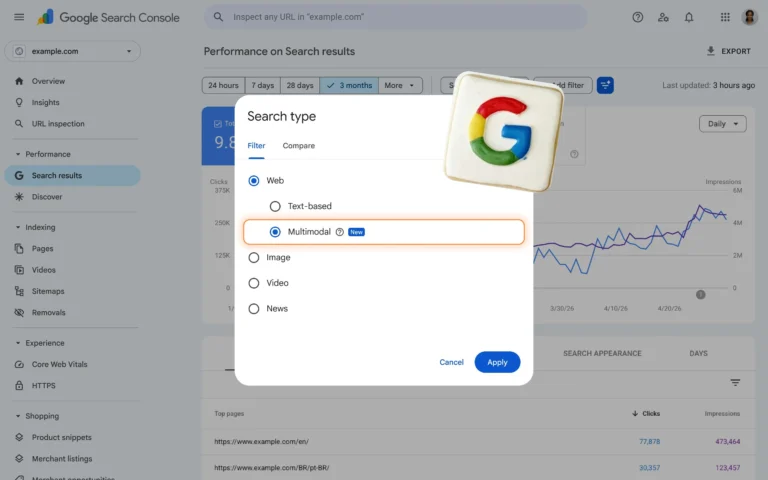
Go to the relevant verification page in Search Console, select Add Property, then choose your platform and follow the on-screen instructions to authorize the connection.
Google also published brand guidelines for how the badge should be displayed. The key requirements:
Keep the clickable target at least 48 × 48 dp on Android and 44 × 44 px on iOS and web. Don’t stretch, distort, rotate, or alter the colours of the “Super G” icon and Search profile button. If you’re using monochrome for all icons, use the monochrome “G” icon. Avoid mixing monochrome badges with colourful badges.
Google provides the code directly in their documentation. It’s a straightforward embed, no custom development required, no plugin needed. Add it alongside your social follow buttons, your newsletter signup, or your site footer. Anywhere your regular audience sees it works.
One thing worth noting: publishers who run into issues implementing the feature are directed to the Google Search Central Help Community, where other users and volunteers, but not actual Googlers might help. If you hit a wall, the official support path is community-based, not direct. Factor that into your expectations.
Here’s where the post shifts from “here’s how to use a new Google feature” to “here’s what Google is actually telling you without saying it.”
The reality is that Google is starving the web ecosystem of traffic. The Search Profile Badge is a break-the-glass measure on the part of Google to make up for all the traffic that AI Search has taken away.
Google has spent 2026 building an entirely new infrastructure for publisher-audience relationships. Search Profiles. Preferred Sources. Tailor Your Feed. Platform Properties in Search Console to track social content. AI impression reports. And now: a Follow button you can embed on your website.
Ask yourself a simple question: why would Google build all of this if AI search was sending more traffic to publishers than before?
The answer is that it isn’t. AI Overviews and AI Mode are answering queries directly and when queries get answered directly, users don’t click through to the sites that provided the source material. Google’s own AI performance reports confirmed that impression data exists, but click data is still missing. The traffic chain is being interrupted.
Search Profiles — and this badge specifically — are Google’s attempt to create an alternative engagement loop: instead of “user searches → clicks your page → visits your site,” the new loop is “user follows your profile → your content surfaces in their Discover feed → they engage with it there.”
That’s a fundamentally different relationship. And it’s worth being clear-eyed about what you’re trading.
Here’s the tension that every publisher and content marketer needs to sit with.
The Follow mechanism creates a direct relationship between your content and a user inside Google’s ecosystem. That’s real value. A follower who sees your content in their Discover feed may be more engaged, more loyal, more likely to click through than a cold organic visitor landing from a search result.
What would be even better is if Google used the follower data to influence what other users see, thereby helping publishers gain a bigger audience while making users happier by showing them content that’s relevant to them.
That’s the upside scenario and it’s plausible. If Google’s follow graph starts functioning like an interest graph, publishers with strong engaged audiences could see meaningful Discover traffic that’s higher-quality than generic organic traffic.
But the downside scenario is also real: you’re building an audience inside someone else’s platform. The followers belong to your Google Profile, not to your CRM or your email list. If Google changes the algorithm, adjusts Discover ranking, or deprecates the feature, your investment walks out the door with it.
This is the fundamental publisher dilemma of 2026, and it’s not unique to Google. Every platform wants your audience to follow you on their surface. The ones who win long-term are the publishers who use those platforms to funnel people into direct relationships, email lists, communities, paid subscriptions not ones who build their entire audience inside someone else’s walls.
The badge is worth adding. Building your entire distribution strategy around it is a different question.
Here’s the market context that frames why Google is building these tools now and why publishers can’t afford to be passive about it.
Organic search traffic has been declining for publishers across the board in 2026. AI Overviews are answering informational queries without clicks. AI Mode is handling complex multi-step research the same way. Zero-click searches, which have been rising for years, accelerated when AI features went mainstream.
Google’s own AI impression reports (rolled out globally on August 31st) showed that click data isn’t even available yet. You can see that your content is appearing in AI features. You cannot see whether anyone is clicking through from those appearances. That gap is where publisher revenue is disappearing.
The Search Profile system of which this badge is the latest piece is Google’s acknowledged response to that problem. The question is whether it’s a meaningful solution or a feature that sounds helpful while the underlying traffic loss continues.
The honest answer: it’s too early to know. The Follow graph is new. The Discover integration for profiles is new. There’s no longitudinal data yet on whether a strong Search Profile following translates to meaningful traffic recovery for publishers who are seeing AI-driven organic decline.
What is clear is that doing nothing, waiting to see what happens, is the worst option. The publishers who build their Search Profile audiences now will have an advantage when the data on conversion starts to emerge.
Stop treating this as “interesting news to revisit later.” Here’s the action sequence:
Step 1: Check if you qualify for a Search Profile. Currently available to US-based publishers and creators with 10,000 or more followers. If you qualify, claim your profile now. The badge is useless without a profile to link to.
Step 2: Claim and complete your Search Profile. Fill in all four components: Enhanced Knowledge Panel, Centralised Content Hub, Google Discover Integration, and Multi-brand Management if applicable. An incomplete profile sends weaker signals.
Step 3: Add the badge to your website. Put it where your regular visitors will see it — site header, sidebar, article footer, About page. Treat it with the same prominence as your newsletter subscribe button. That’s the right framing: this is an audience-building mechanic, not a decorative element.
Step 4: Follow Google’s brand guidelines. Keep the clickable target at least 48 × 48 dp on Android and 44 × 44 px on iOS and web. Maintain logo integrity — don’t stretch, rotate, or recolour the assets. If using alongside a Preferred Sources badge, use the higher emphasis Search Profile button with a label for clear distinction.
Step 5: Treat it as one leg of a three-part distribution strategy. The badge builds your Google audience. Your newsletter builds your owned audience. Your social presence builds platform-specific audiences. None of these replaces the others. A publisher in 2026 who is relying on any single distribution channel — organic search, social, or now Google Profiles — is one algorithm update away from a crisis.
If this is an evolution of Google’s relationship with the web ecosystem, then Search Profile Badges point to Google becoming a follower ecosystem. AI Search is a structural shift in how content gets consumed and the traffic patterns publishers have depended on for a decade are not coming back in the same form.
The badge is real, it’s easy to implement, and it’s worth doing today. But the bigger strategic conversation it should trigger is this: what does your distribution strategy look like in a world where Google sends less referral traffic and more Discover-based engagement? Where your audience follows you on Google the way they once followed you on Twitter?
Publishers who answer that question now who build owned audiences, diversify distribution, and use every available tool including this badge will be in a fundamentally stronger position than the ones who are still waiting for organic traffic to recover.
It won’t recover to where it was. Build for where it’s going.
Sources:
Add a Search Profile Badge to Your Website — Google Search Central
If you have already tested the platform, Share your valuable reviews here and help others fix this, If You liked our content or found it helpful, pls Comment Below!
Get practical insights on AI, SEO, marketing strategy, and emerging technology, we cut the noise so you enjoy true content




Leave a Reply