Physical Address
304 North Cardinal St.
Dorchester Center, MA 02124
Physical Address
304 North Cardinal St.
Dorchester Center, MA 02124


AI search didn’t make SEO obsolete. It made bad SEO catastrophic and good SEO more valuable than it’s ever been. Here’s the angle nobody’s talking about.
There’s a narrative that’s been running through marketing circles for the past 18 months. It goes something like this: SEO is dying, GEO and AEO are the new game, and anyone still talking about technical SEO is basically sharpening a pencil in a world of keyboards.
It’s wrong. And the irony is that the AI revolution, the exact thing people are using to bury SEO has made a strong SEO foundation more critical than it has ever been.
Here’s the angle that most people are missing: AI search doesn’t replace the need for SEO. It exposes whether you had it in the first place. The brands that invested properly in technical SEO, information architecture, and entity signals are the ones getting cited in AI answers. The ones that didn’t are invisible not just on Google, but across every AI surface that people are now using to make decisions.
Let’s break this down completely.
When AI Overviews rolled out and publishers started watching their referral traffic crater, the industry response split in two directions.
One camp said: SEO is dead, pivot everything to GEO and AEO, start optimizing for AI citations instead of rankings.
The other said: Nothing has changed, keep doing what you were doing, this is just a new feature.
Both are wrong. And the reason both are wrong is the same: they misunderstood how AI search actually works under the hood.
Here’s the reality. Google confirmed search queries have reached an all-time high. More searches than ever are happening but the interface is retaining users longer before sending traffic out. AI Overviews answer a question inside Google rather than routing you to a website. The funnel is the same. The switchboard just got smarter.
Meanwhile, referral traffic to publishers is being squeezed small publishers have seen search referral traffic fall as much as 60% and Oxford research suggests publishers expect traffic to halve within three years.
So you have record search volume and collapsing referral traffic simultaneously. That sounds like a contradiction. It’s not. It means AI search is doing more of the answering and the brands that power those answers are the ones with the technical infrastructure to be cited. Everyone else is just watching their traffic numbers decline while search volume climbs without them.
To understand why SEO is more important than ever, you need to understand a basic fact about how large language models operate one that gets glossed over in most marketing coverage.
LLMs are not databases. They don’t retrieve stored facts the way a search engine crawls an index. They are probabilistic text-generation engines: they calculate the statistical likelihood of word sequences based on training data. Left to their own devices, they hallucinate, go stale, and make confident-sounding errors.
To make AI answers current, accurate, and grounded, AI search engines use something called Retrieval Augmented Generation (RAG). Before the model writes its response, the system fetches live documents from a search index, feeds them to the model as context, and the model generates its answer from that retrieved material.
Read that again, because it’s the crux of everything: AI search still relies on a search index. And a search index only works if the content feeding it is well-structured, crawlable, and semantically clean.
Who builds that? SEO does.
Semantic HTML. Logical site hierarchy. Clean indexing paths. Schema markup. Internal linking that gives machines a navigable map of your content. Entity signals that tie your brand to verifiable facts across the web. Every single one of those things which SEO professionals have been building and maintaining for years is what AI search engines need to do their job.
Without it, AI search is looking at a messy, poorly labeled data source. It can still generate an answer. It just won’t be citing you.
Here’s the reframe that changes how you should think about this.
In the old SEO world, technical excellence was the floor, the minimum you needed to rank. The ceiling was built on links, content volume, and authority. You could get away with mediocre technical SEO if your link profile was strong enough.
In the AI search world, technical excellence is the trust signal. AI models don’t just need to find your content, they need to be able to verify it, attribute it, and cite it with confidence. A poorly structured site with unclear entity signals and thin information architecture isn’t just hard to rank. It’s hard to trust. And an AI that can’t clearly interpret what your page is about and who it belongs to won’t stake its answer on it.
The implication: brands that treated technical SEO as a checkbox item are now invisible in AI answers, not because AI search dislikes them, but because AI search can’t confidently read them.
And there’s a second layer that makes this even sharper.
AI search cross-references. When a model assembles an answer, it doesn’t pull from a single source. It looks for corroboration does this fact appear across multiple credible sources, does this entity appear consistently across the knowledge graph, does this brand’s digital footprint support the claim being made? Strong entity signals, consistent structured data, and clean information architecture are what make your brand legible across that cross-referencing process.
SEO built all of that. And now AI needs all of it.
This isn’t just an analyst’s opinion. Google’s own VP of Search and Commerce, Brendon Kraham, made it official in a June 2026 Google article.
Kraham’s message is unusually blunt for a Google executive: AI Mode and AI Overviews are built directly on top of Google’s core ranking and quality systems. The generative AI features retrieve content from the existing search index. Which means the formula for success hasn’t changed, foundational SEO is still the only launchpad that works.
He went further, telling CMOs exactly what to take off their team’s plate:
Stop optimizing for bots. No keyword-stuffed copy. No artificial content chunking. No special AI text files like LLMs.txt. Google’s systems understand language like a human, writing for machines at the expense of humans actively hurts you.
Stop chasing inauthentic mentions. Google’s AI features can detect what’s being said about brands across the web, including in blogs, forums, and video. Manufactured mentions are not helpful and they’re becoming easier to identify.
Stop worrying about the new names. GEO, AEO, LLM SEO, Kraham’s position is that these are all just SEO. The terminology changes. The underlying requirements don’t.
This is Google’s VP of Search telling CMOs directly: the brands wasting budget on AI-specific workarounds are solving the wrong problem. Your existing SEO investment is your AI search strategy. Treat it that way.
The reason this still matters for many marketing teams is that they’re doing the opposite, spinning up “AI optimization” programs disconnected from their SEO infrastructure, chasing Reddit mentions and AI content seeding strategies while their underlying site architecture is still a mess that machines can barely navigate.
You cannot shortcut your way to AI citations if your digital foundation doesn’t support machine readability. The order of operations matters: foundational SEO first, then everything else on top of it. The brands getting this backward are spending on the latter while neglecting the former and wondering why the citations aren’t materializing.
This is where the rubber meets the road. If you accept that AI search is powered by the same infrastructure SEO has always built, what specifically does “AI-ready” mean?
Information architecture that answers questions, not just ranks for keywords. AI models assemble answers. They need pages that are structured as answers clear headers that match question intent, direct opening statements that state the key point before elaborating, content organized the way an explanation flows rather than the way a sales page converts.
Entity clarity across your entire digital footprint. AI search uses the knowledge graph to verify who you are. Your brand, your key people, your products all need to be consistently named, described, and cross-referenced across your owned properties and authoritative third-party sources. Inconsistency between your site, your Wikipedia presence, your Google Business Profile, and your industry citations creates entity ambiguity that makes AI less confident about citing you.
Schema markup that tells machines what you’re actually saying. Structured data is how you label your content for machines. Article schema, FAQ schema, product schema, organization schema, these are not optional nice-to-haves in an AI search world. They’re the metadata layer that helps models interpret and trust your content at retrieval time.
Clean crawl paths with no dead ends. RAG retrieves documents. If your crawl architecture has orphaned pages, redirect chains, blocked resources, or noindex tags applied to content you actually want cited the retrieval layer can’t reach it. You might as well not have published it as far as AI search is concerned.
Genuine information gain on every page. AI models evaluate whether a page adds something new to the conversation or just repeats what’s already in their training data. Thin content, generic summaries, and “best X in 2026” listicles that don’t contain original analysis are getting bypassed. Pages that contain specific data, original perspective, or expert-level depth are the ones that get surfaced and cited.
Kraham’s framing here is worth borrowing for your team: he calls it “noncommodity content.” The example he uses is sharp a local running store that publishes a deep-dive video analyzing why a specific customer’s shoe collapsed, rather than a generic “Top 10 Running Shoe Tips” article. The specific, experience-backed content wins because it contains something a machine can’t fabricate and a competitor can’t replicate. Your first-hand experience, your internal experts, your proprietary data that’s the content AI search cites because it’s the only content that genuinely earns a citation.
A fast, clean web experience, especially for AI-referred visitors. This one’s easy to overlook but Kraham flagged it explicitly: people arriving from AI surfaces are often more informed, more intent-driven, and closer to converting than typical organic visitors. If they land on a slow, cluttered, or mobile-broken experience, you’ve wasted the warmest traffic your site will see. Reducing latency, optimising for all devices, and making the main content immediately legible aren’t nice-to-haves, they’re the conversion layer that sits on top of everything else.
Merchant Center and Google Business Profile for product and local brands. If you sell products or operate locally, these aren’t optional channels anymore. Kraham was specific: Merchant Center feeds and Google Business Profile information are now being surfaced directly inside AI responses and AI search results. If your product and local data isn’t clean and current in both, you’re invisible in a placement that competitors with properly maintained feeds are winning by default.
If you’re taking this to a CMO or CFO, here’s the framing that lands.
The AI search landscape is compressing margins on undifferentiated content. The middle of the internet with decent content, decent site, decent SEO is being absorbed into AI answers without attribution. Those sites lose traffic while their content powers someone else’s AI citations.
The brands that win AI attribution are those with the strongest information architecture, the clearest entity signals, and the most genuinely useful content. All three of those are built through SEO. None of them are built through AI citation hacks or manufactured forum mentions.
The investment case is simple: every dollar you put into technical SEO, content depth, and entity clarity today is building the infrastructure that determines your AI search visibility for the next three to five years. Every dollar you don’t put in is lending that territory to competitors who are.
Audit for machine readability, not just rankings. Run your site through the lens of: can an AI retrieval system find, read, and understand this content? Check your crawl architecture, your schema implementation, your page structure. The ranking report is less important right now than the readability report.
Map your entity signals across the knowledge graph. Search your brand name on Google. Check your Knowledge Panel. Cross-reference how you’re described on Wikipedia, Crunchbase, LinkedIn, industry directories, and major publications. Every inconsistency is an entity signal that creates ambiguity for AI models trying to verify and cite you.
Rebuild your content strategy around noncommodity depth. Audit your existing content for pages that contain only generic information available everywhere. These pages are not getting cited. Priorities pages that contain original data, first-hand experience, or expert-level depth that doesn’t exist elsewhere. That’s the content AI search cites because it’s the only content that earns a citation rather than a paraphrase.
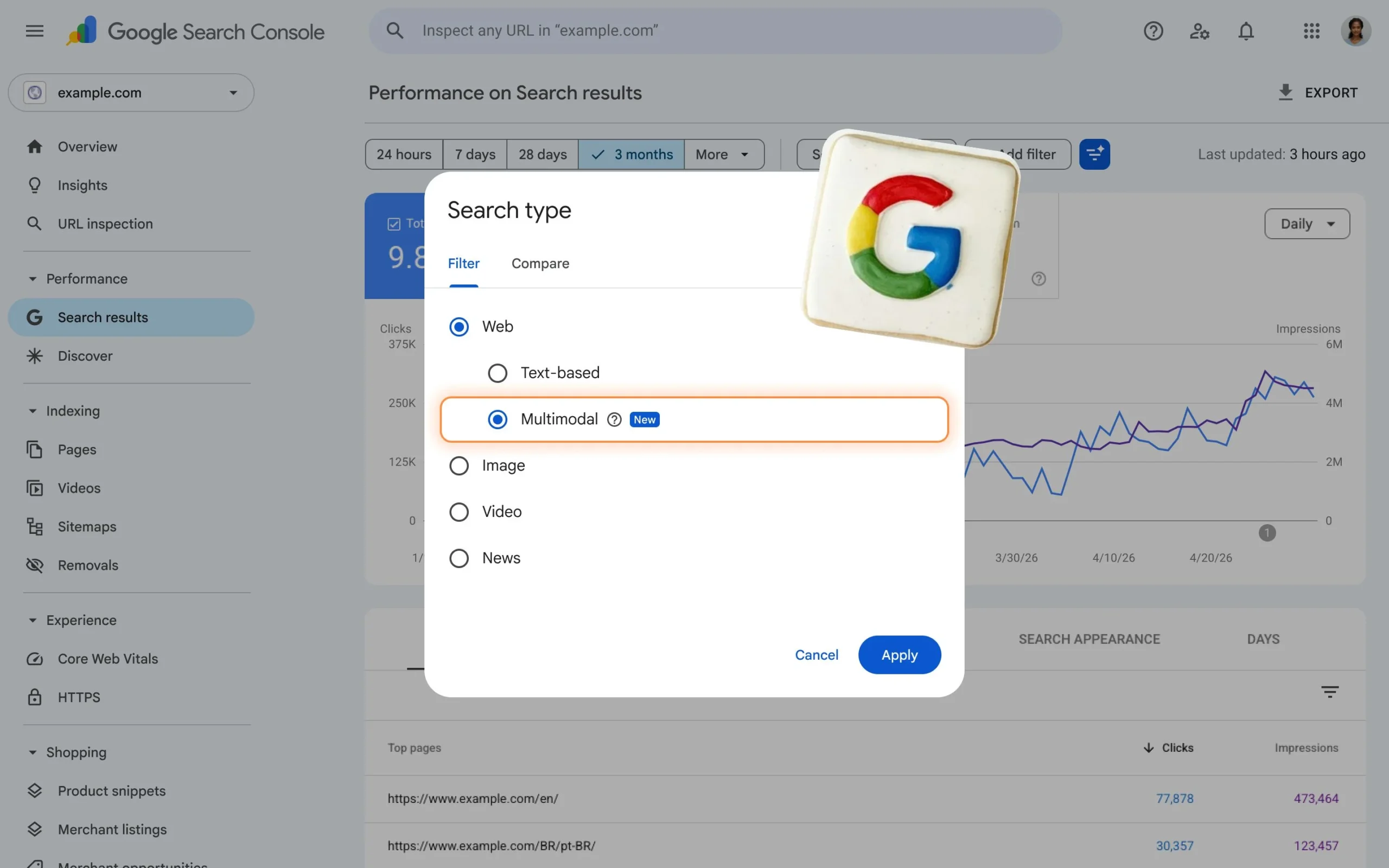
Set up your AI search measurement baseline now. Google Search Console has begun rolling out new performance reports showing impressions from AI features specifically separate from traditional organic. If you’re a retailer, Merchant Center now has reporting on how product listings are appearing across generative AI features. Get these baselines established before your competitors do. You cannot optimise what you are not measuring, and right now most marketing teams are flying blind on their AI search visibility because they haven’t connected to the right data sources yet.
The AI search transition didn’t make SEO obsolete. It raised the stakes for it.
The brands that treated SEO as a marketing checkbox, something you maintain to avoid falling off a cliff are now discovering that the cliff arrived anyway. AI search doesn’t reward functional SEO. It cites exceptional SEO: clean architecture, strong entities, genuine depth, and content structured for machine retrieval.
The brands that invested properly in SEO foundations aren’t scrambling to understand AI search. They’re already inside it. Their content is being retrieved, their entities are being verified, their citations are being generated, because they built the infrastructure that makes all of it possible.
GEO, AEO, AI search optimization, these are extensions of SEO thinking, not replacements for it. The sooner you treat them that way, the sooner you stop chasing AI visibility and start building it.
The engine room was always the most important place to be. In an AI search world, it’s the only place that matters.
Sources: Dan Taylor, “AI Search Is Nothing Without SEO & It Knows It,” Search Engine Journal, July 2026. Brendon Kraham, “Good SEO is good GEO — Create & capture demand in the AI Search era,” Think with Google, June 2026.
Get practical insights on AI, SEO, marketing strategy, and emerging technology, we cut the noise so you enjoy true content
If You liked our content, pls Comment Below!