Physical Address
304 North Cardinal St.
Dorchester Center, MA 02124
Physical Address
304 North Cardinal St.
Dorchester Center, MA 02124

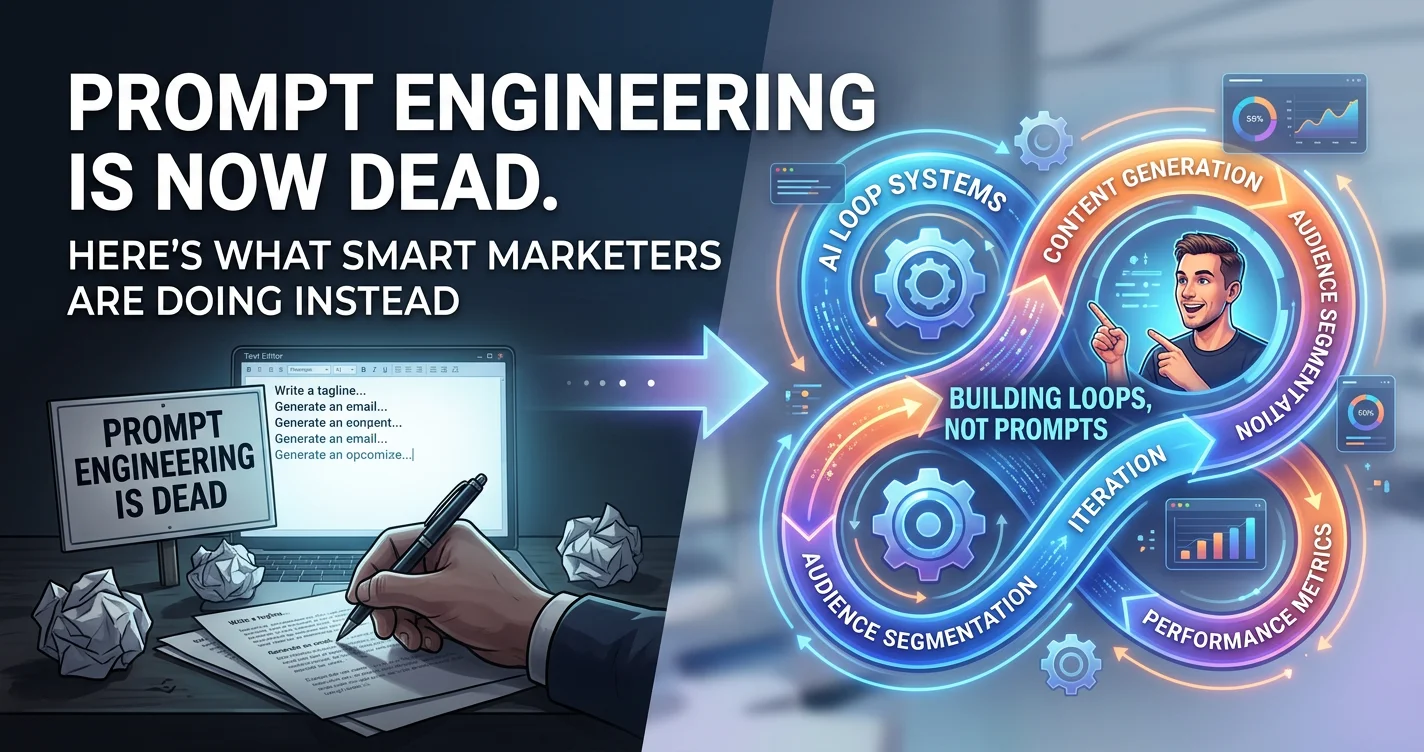
The man who built the world’s most-used AI coding tool, Boris Cherny, the Anthropic co-founder just told you to stop writing prompts. Are you listening?
trade agreements, and defense collaborations now reflect a world where authority is more evenly distributed, and no single country dominates global affairs
Boris Cherny, the Anthropic co-founder who heads up Claude Code, recently dropped a line that sent shockwaves through the AI community:
“I don’t prompt Claude anymore. I have loops running. They’re the ones prompting Claude and figuring out what to do. My job is to write loops.”
Read that again slowly.
The person who built one of the most powerful AI tools on the planet doesn’t write prompts anymore. He builds systems that do the prompting for him — automatically, continuously, without him in the room.
This isn’t a niche developer conversation. This is the clearest signal yet about where AI-powered work is heading — and marketers who ignore it will spend the next two years wondering why their competition is running laps around them.
Let’s break down exactly what this means, why it matters to you, and what you should actually do about it.
Cherny isn’t some Silicon Valley influencer. He’s the head of Claude Code at Anthropic — the product that has, by most measures, dominated the AI coding market. Claude Code commands over half of the AI coding market, and since going generally available in 2025, it crossed $1 billion in run-rate revenue.
Cherny himself stopped writing code by hand over two months ago. He now ships 20+ pull requests a day — each one 100% AI-generated. On top of that, he said company-wide at Anthropic, between 70% and 90% of all code is AI-generated.
When this guy says the era of prompting is over, it’s not a hot take for engagement. It’s a practitioner telling you what the frontier actually looks like right now.
Here’s the progression, fast and clean:
Stage 1 — Prompt Engineering (2022–2024) You learn how to talk to AI. Crafting inputs, chaining thoughts, adding context. You got better at asking. The AI got better at answering. Everyone felt productive.
Stage 2 — Context Engineering (2024–2025) You realize the prompt isn’t the whole game. What the AI knows when it answers matters just as much. You start feeding it better documents, clearer briefs, more structured background. You’re still in the conversation, but you’re curating the room.
Stage 3 — Loop Engineering (2026 → now) You exit the conversation entirely. Instead of typing prompts, you build a system that types prompts for you — one that runs autonomously, checks its own output, corrects itself, and keeps going until the goal is done.
As Cherny put it on CNBC: “It’s an agent that prompts Claude. I don’t write the prompt anymore. Claude writes the prompt, and now I’m talking to that new Claude that is kind of coordinating.”
That’s not a workflow tweak. That’s a fundamentally different relationship with AI.
The cron job analogy: A cron job does the same thing at the same time every day. A loop checks the situation first, then decides what to do. The intelligence is inside the loop — not in your hands.
You might be thinking: “That’s a coding thing. I don’t write code.”
Wrong framing. Let me show you what loop engineering looks like in a marketing context.
You are the bottleneck. Every piece of content requires you to be present, thinking, prompting.
You’ve moved from being the worker to being the architect of the system that does the work.
This isn’t theoretical. This is what the top 1% of marketing operators will be doing — and in many cases are already doing — by the end of 2026.
A prompt is a question. A loop is a mission briefing.
The shift in mindset: instead of asking “how do I get Claude to write this better?”, ask “how do I define success so that a system can verify whether this task is done?”
Every loop needs a stopping condition. Every system needs a definition of done. Your job as a marketer is to get extremely good at articulating goals in verifiable terms.
One is a request. The other is a system specification.
Most marketers still use AI the way they used Google — one question, one answer, move on. That’s leaving 90% of the value on the table.
When you hire a marketing coordinator, you don’t send them one Slack message and wait. You set them up with context, processes, tools, and recurring responsibilities. You check in on outcomes, not inputs.
That’s exactly how you should think about AI agents now. Give them context. Give them tools. Give them recurring workflows. Check their work — don’t manage their keystrokes.
Here’s the uncomfortable truth: prompt skills commoditize fast. As models get better, the gap between a “good prompt” and a “bad prompt” narrows. The AI fills in gaps you used to have to bridge manually.
What doesn’t commoditize is system thinking. Knowing which workflows to automate. How to define quality in ways an agent can verify. How to stitch tools together. How to build loops that produce consistent output without constant babysitting.
The marketers who win in the next 24 months won’t have the best prompts. They’ll have the best systems.
Cherny’s own hiring philosophy changed with this shift. His team now hires generalists who can build and orchestrate — not specialists locked into traditional skill sets. “The model can fill in the details,” he said. “Not all of the things people learned in the past translate.”
Same question for your marketing team: are you hiring people who are good at using tools, or people who are good at building the systems those tools run inside?
The former will be increasingly outpaced. The latter are your leverage multipliers.
This one’s counterintuitive. Loops aren’t free. Running agents autonomously — especially ones that self-check, retry, and spawn sub-tasks — burns compute. It’s expensive upfront.
But here’s the math Cherny laid out: shift budget from humans to tokens. The upfront token cost is a one-time design investment. Once the loop runs, every future execution is faster, cheaper, and more consistent than having a human do it manually.
The teams that front-load the cost and build the system compound. The ones paying human-hours every single time don’t.
Let’s get tactical, because this is your world.
Content production loops — an agent that monitors your target keyword rankings, identifies content gaps weekly, drafts briefs, and routes them for approval — can replace what currently takes a coordinator several hours a week. Every week. Forever.
SEO audit loops — instead of running a quarterly Screaming Frog crawl and hoping someone acts on it, a loop monitors site health continuously, flags issues, and logs them into your project management system automatically.
Competitor monitoring loops — track competitor content, ad copy changes, backlink acquisitions, and new product pages on a schedule, and surface weekly digests without you lifting a finger.
Email personalization loops — instead of writing one version and blasting it, a loop that generates segment-specific variations, tests subject lines, and feeds performance data back into the next round.
None of this is science fiction. The infrastructure — agents, tools, scheduling, memory — is all available right now. What’s missing in most marketing organizations is the decision to stop optimizing individual prompts and start designing these systems.
Loop engineering isn’t magic. It comes with real constraints you need to plan for:
Cost spikes are real. Loops that run long and spawn sub-agents can burn significantly more compute than single prompts. You need budget guardrails and monitoring baked in from day one.
Garbage in, garbage out — at scale. A badly designed loop doesn’t just produce one bad output. It produces bad outputs continuously until someone catches it. Define quality checks. Build verification steps. Don’t skip the review layer.
Not everything should be looped. One-off tasks, nuanced creative decisions, relationship-driven work — these don’t benefit from autonomous loops. Know the difference between work that’s repetitive and verifiable (loop it) versus work that requires human judgment every time (don’t).
Boris Cherny isn’t predicting the future. He’s describing the present — at least, the present that the most sophisticated AI practitioners are already living in.
The era of prompt engineering isn’t fully dead. But it’s the floor now, not the ceiling. It’s table stakes — the basic competency you need before you can even think about building the next layer.
The next layer is systems. Loops. Automated workflows that run while you sleep, produce output while you’re in meetings, and compound value over time without requiring your constant presence.
For marketers, the opportunity is enormous. Most of your workflows — content, SEO, reporting, research, outreach — are exactly the kind of repetitive, goal-verifiable tasks that loops were designed to handle.
The question isn’t whether this shift is coming. It’s already here.
The question is whether you’re going to build the systems that run your marketing — or keep manually running it, prompt by prompt, while the people who moved faster pull ahead.
The era of talking to AI is giving way to the era of building with it. The marketers who make that mental switch first won’t just be more productive — they’ll be operating in a different league entirely.