Physical Address
304 North Cardinal St.
Dorchester Center, MA 02124
Physical Address
304 North Cardinal St.
Dorchester Center, MA 02124

Published: July 13, 2026 | Category: AI & Marketing Strategy
Here’s a question you probably haven’t asked out loud yet: when your team uses AI tools every day, who actually gets smarter you, or the vendor?
Microsoft CEO Satya Nadella just answered it. And if you’re a marketer, a brand strategist, or a business leader who’s been enthusiastically feeding AI tools your briefs, your workflows, your corrections, and your internal logic, you need to read what he said carefully.
On July 12, 2026, Nadella published an essay introducing a concept he calls the Reverse Information Paradox. It passed two million views within hours. The reason it spread that fast is simple: it named something a lot of people were quietly sensing but hadn’t found the language for.
Let’s break it down.
To understand Nadella’s argument, you need one minute of economics context.
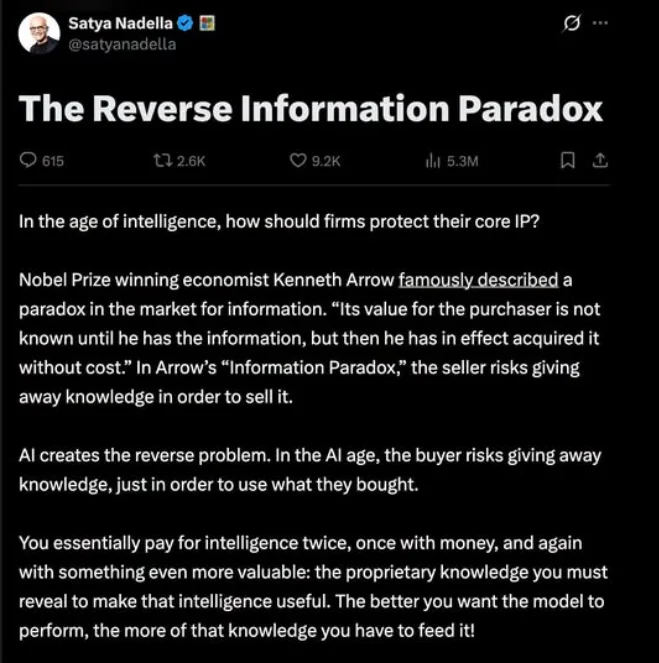
In 1962, Nobel Prize-winning economist Kenneth Arrow described what’s called the information paradox: sellers of information face an impossible problem. To convince a buyer the information is worth purchasing, they have to reveal it, but once they reveal it, the buyer already has it for free. The seller is always exposed.
For 60 years, that was the seller’s problem.
Nadella argues that AI has completely flipped this dynamic. In the AI age, it is the buyer who is now exposed. “You essentially pay for intelligence twice,” he writes, “once with money, and again with something even more valuable: the proprietary knowledge you must reveal to make that intelligence useful.
That’s the Reverse Information Paradox. The seller – the AI vendor – no longer risks giving away too much. The buyer does.
And here’s the kicker: the better you want the model to perform, the more of that knowledge you have to feed it.
This is where marketers need to pay close attention, because the leak isn’t dramatic. It’s not a data breach. It’s subtle, constant, and cumulative.
Three things are leaking, and they sound technical but aren’t. Your prompts: the questions your team asks, which reveal what you are working on. Your corrections: every time someone tells the model “not like that, in my industry this works differently,” that is in-house expertise turned into data. And your evals: the internal benchmarks you use to measure whether the AI is doing a good job, which are, quite simply, your definition of quality.
Nadella calls all of this “exhaust” , not the main product of your AI usage, but what comes out of your engine as you use it.
“Every correction is distilled into institutional know-how,” Nadella stated. “It’s the kind of knowledge a competitor could never buy, and the kind that leaks almost imperceptibly: trace by trace, correction by correction, eval by eval. In consuming intelligence, you are creating intelligence. And what you create should belong to you.
Think about what that means in a marketing context specifically. Every time your team:
…you are creating proprietary intelligence. And depending on your vendor’s terms, that intelligence may be compounding somewhere you don’t control.
Nadella pointed out a particular irony in the current status quo: model providers use fair use rights to train on public data, but then impose restrictive terms on distillation and reserve the right to learn from customer usage.
In plain English: they can learn from you, but you can’t learn from them in return.”Over time, the information asymmetry becomes increasingly skewed because the seller learns more about the buyer, while the buyer learns very little about what the seller learns in return.”
This is the asymmetry that should bother every marketer and business leader using AI at scale. You are not just a customer. You are, in many cases, also a data source. And the two roles come with very different power dynamics.
The analogy that makes it land: it’s like hiring a brilliant consultant who bills by the hour and, on top of that, writes down in a notebook everything they learn about your business. When the contract ends, the notebook leaves with them. And tomorrow they can sign with your competitor.
Nadella isn’t just diagnosing the problem. He outlines what the solution requires, and it goes beyond standard data protection settings.
His proposed fix is a hard trust boundary inside each enterprise tenant – a wall across which nothing crosses without explicit consent. Not prompts, not tool traces, not evals, not adapted model weights, not memory. The goal: every element of that exhaust compounds as a proprietary enterprise asset rather than disappearing into a shared model.
He structures the path forward around five principles he calls the Five C’s:
Control – Own your private evaluations. Don’t let your definition of “good output” live inside a vendor’s system.
Capability – Retain ownership of your organizational memory. The institutional knowledge your team generates while using AI should stay yours.
Choice – Decouple your orchestration layer from any single model. Don’t get locked into one vendor’s ecosystem when the model landscape is still commoditizing rapidly.
Cost – Build for long-term efficiency, not short-term convenience. Vendor lock-in always costs more eventually.
Compound – Combine the first four into a continuous learning loop that belongs to the firm, not the vendor. When models converge and are rented by everyone, the durable enterprise moat is not which model you use, it is the proprietary learning loop you build around the model.
Nadella quoted Palantir CEO Alex Karp directly: “What the technical customers want is control over their compute, their models, their data stack, and their alpha. They want to know they own the means of production, and it’s not being transferred to someone else.”
Here’s why that matters: Karp and Nadella run two companies that both profit from selling you AI infrastructure. When the people selling you the tools are telling you to own what you build with those tools that’s not a sales pitch. That’s a warning.
When the man selling you the shovel tells you the mine should be yours, the argument can no longer be denied.
Let’s bring this out of the abstract and into the practical, because this isn’t just a concern for CTOs and enterprise architects.
If you’re a brand or marketing team using AI tools at scale, here’s what to audit immediately:
1. Where do your prompts go? Read the terms of your AI tools. Specifically look for language around model training, usage data, and whether your inputs can be used to improve the model for other customers.
2. Who owns your corrections? Every time your team refines an AI output, that refinement is a data point. If that data point is training the vendor’s model, your brand knowledge is effectively subsidizing their product.
3. Are you building a proprietary system or renting someone else’s? There’s a difference between using AI tools tactically and building a learning infrastructure that compounds over time. Most marketing teams are doing the former when the competitive advantage lives in the latter.
4. What is your orchestration strategy? If your entire AI workflow runs through a single vendor’s ecosystem, you have no leverage and no portability. Decoupling your orchestration layer, even partially protects you from lock-in and gives you the ability to switch as models commoditize.
5. Are you documenting your own intelligence? Your brand voice guidelines, your quality definitions, your prompt frameworks, your evaluation criteria, all of this should exist as proprietary documented systems that you own, not just implicitly embedded in a vendor relationship.
Nadella is doing something more precise than issuing a privacy warning. He is relocating the definition of enterprise competitive advantage in the AI era.
His core argument is this: models are commoditizing. Within a few years, the underlying AI capability will be accessible to everyone at roughly the same price. At that point, the competitive edge won’t come from which model you use. It will come from the proprietary learning loop you’ve built around it.
The marketers and brands who win in that environment will be the ones who treated their AI usage as an asset-building exercise, not just a productivity tool. Every prompt refinement, every correction, every workflow optimization is a piece of institutional intelligence. The question is whether it’s compounding in your favour or someone else’s.
If learning flows in only one direction, economic value converges toward the infrastructure owners rather than the knowledge creators.
Don’t be the knowledge creator funding someone else’s infrastructure.
Sources:
Get practical insights on AI, SEO, marketing strategy, and emerging technology, we cut the noise so you enjoy true content
If You liked our content, pls Comment Below!